Consider two people who graduated medical school on the same day.
The first spent the next decade in a narrow surgical subspecialty. She saw thousands of cases, developed extraordinary pattern recognition in her particular domain, and can now diagnose her specialty conditions from across the room. Inside her lane she is devastating. Outside it she is surprisingly ordinary. When a patient presents with something that looks like her specialty but is actually something else, she tends to see what she has trained to see. Her colleagues notice that she occasionally misses unusual presentations, because her reading snaps them into familiar categories before she can catch herself.
The second doctor rotated broadly. Emergency medicine, rural practice, international health, a stint in public health policy. She has seen more variety, developed a wider lens, and can connect unusual symptoms across disciplines. She is harder to fool with ambiguous cases. She is also, on any given procedure, less precise than the specialist. She lacks the deep grooves of ten thousand repetitions.
Which doctor learned better?
The honest answer is that it depends on the question you are asking. Inside her specialty, the specialist’s readings are sharp and accurate. Drop her into a patient population her training did not anticipate, whether that means an unusual demographic, an atypical presentation, or a novel pathogen, and her readings start to fail in ways the generalist’s would absorb.
Two simple ways to hold the pair in mind. Bias is how systematically off a lens is in its sweet spot. Variance is how thrown around the lens gets when the world changes. The specialist’s lens has very low bias in its lane and high variance outside it. The generalist’s lens has higher bias in any one domain. She cannot match the specialist’s resolution. Her variance across all of medicine, though, is lower. She is harder to throw off.
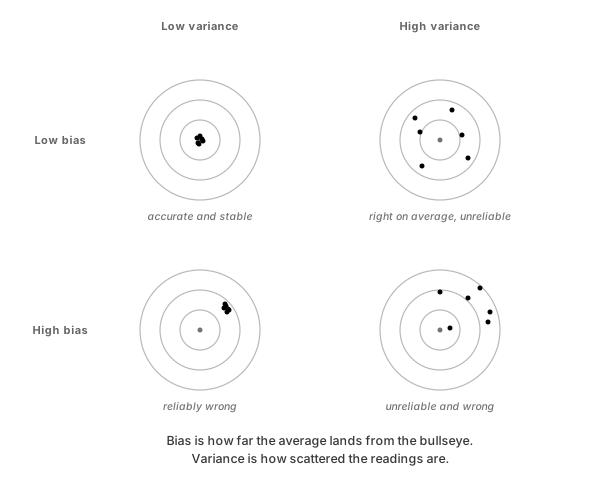
This is the bias-variance trade-off, and the deepest claim of this essay is that the trade-off is not a quirk of statistical theory. It is a constraint on any learner that has to build a model from finite experience in a world that keeps changing. It governs how you read a market and how a family interprets bad news, how a regulator misses a crisis and how a hospital algorithm reads a patient.
Any lens has to choose where to put its resolving power. No lens has high resolution everywhere. No belief model has low bias and low variance at the same time. The choice is structural. The only question is whether you make it deliberately or let it get made for you by the accidents of your training data.
A belief model. That phrase is doing a lot of work, and it is worth slowing down for. The two doctors did not just arrive at different opinions. Something inside each of them, fitted by a decade of different data, produced the different opinions. The rest of this essay is about that thing.
What a belief actually is
Belief Agency argued that beliefs are something you can take ownership of. The Most Dangerous Word argued that the single word belief is doing six different jobs at once. This piece pushes one layer down.
When you look closely at what a belief actually is, the folk picture breaks. A belief is not a fact filed in your head. It is the output of an apparatus that takes in signals from the world and produces interpretations, expectations, and actions. The simpler word for that apparatus is a model.
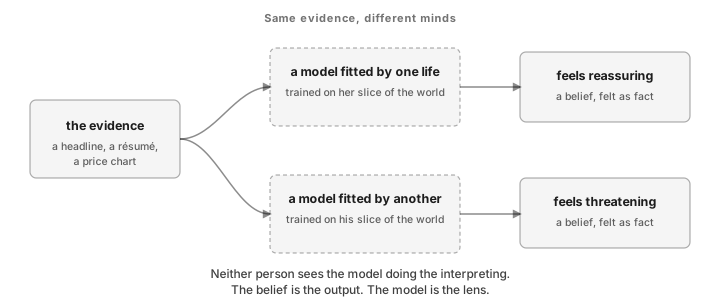
Walk to a meeting and you have a belief about how it will go. You did not retrieve it from a list. Your model of “meetings like this” produced it from whatever inputs you had, in roughly the way a trained neural network produces a prediction when you feed it an image. Looking at a stranger works the same way. So does reading a price chart, scanning a paragraph, or smelling smoke. Every act of perception is your model returning an output. The belief that surfaces is the prediction. The model is the lens.
You almost never see the model. You see its outputs, which arrive in your awareness as beliefs that feel like direct readings of the world. The philosopher Eric Schwitzgebel calls the underlying apparatus your dispositional profile, the pattern of cognitive, behavioural, and emotional tendencies that quietly does the work of interpretation. It is what makes the same news item feel reassuring to one person and threatening to another, or the same résumé impressive to one reader and suspicious to another. Same evidence, different minds, different beliefs.
This has a sharp consequence. If the model is wrong, the beliefs it generates are wrong, and you will not see the model. You will only see the wrong beliefs. They will arrive with the same character of direct perception as any other belief. The model is the lens, and the lens cannot see itself.
Go back to the two doctors with this in hand. Neither of them chose her lens in any direct sense. Each spent a decade feeding her model a different distribution of experience, and each model tightened around its own data. The specialist sees familiar categories everywhere because her model has ten thousand repetitions saying they are usually there. The generalist sees connections across domains because her model was never allowed to settle. If you want to take real ownership of your beliefs, auditing them one by one is not enough. You need a way to think about the model that produces them, and the bias-variance toolkit is the most useful one that transfers cleanly.
What your career teaches you about your belief model
The doctor example is clean because medicine has measurable outcomes. The same dynamic plays out, less visibly, in your own career.
Every year you work, your model fits itself a little more to the data of your professional experience. It lives in your intuitions and heuristics. It shapes your read on people, on situations, on what is about to happen next. Early in a career the model is loose. You don’t know what you don’t know, and you are open to surprise. This is the high-variance phase. You absorb a lot, make big mistakes, and change direction readily.
As you accumulate experience, something shifts. The model tightens. You develop priors, which are strong expectations about how things should go. Meetings follow patterns. Certain emails go in the ignore pile. Decisions get faster. The fluency is enormously valuable, and it is also the start of a trap.
The tighter the model gets, the more it reflects the specific distribution of your past experience. When that distribution stays stable (same industry, same role, same culture), your tightened model is accurate and efficient. You become the specialist. When the distribution shifts (new technology, new market, new culture), the same model starts producing confident errors. You pattern-match on the old regime and miss the new one. You become the expert who is “fighting the last war.”
This is what machine learning calls overfitting. The model has learned its training data too well, including noise and accidents that were never the real signal, and it stumbles on data drawn from a different world. The pattern shows up everywhere. The veteran salesperson stuck in last year’s product category. The startup manager whose playbook works at fifty people and creates chaos at five thousand. The economist whose models held cleanly from 1990 through 2007 and shattered when 2008 arrived.
The unsettling part is what overfitting feels like from the inside. It does not feel like being wrong. It feels like being certain. The model is producing crisp, confident outputs because it has internalised the patterns of a world you used to live in. The crispness is not a signal that you are right. It is a signal that your model is well-fitted to a distribution that may no longer be yours.
The mirror failure is underfitting. The model is too coarse to capture the real patterns. The new graduate with a handful of frameworks but no judgement. The generalist who can talk about anything and execute on nothing. The consultant whose slide deck fits every client because it fits none. Underfitters are wrong in a different way from overfitters. They know they don’t know, more or less, and feel the gap. Overfitters don’t see the gap. Their model fills it confidently with patterns from a regime that has expired.
Between overfitting and underfitting lies a narrow valley. Your career, if you navigate it well, is the process of finding and staying in that valley as the terrain shifts beneath you. The same is true for your belief model in any domain. The valley is not a destination but a moving target.
Try the interactive figure below. The slider controls a polynomial’s complexity. Drag it left for a rigid model (high bias, low variance), right for a flexible one (low bias, high variance), and watch the gap between training error and test error open up as complexity grows. Click “Resample Data” to regenerate the noise and watch variance in action.
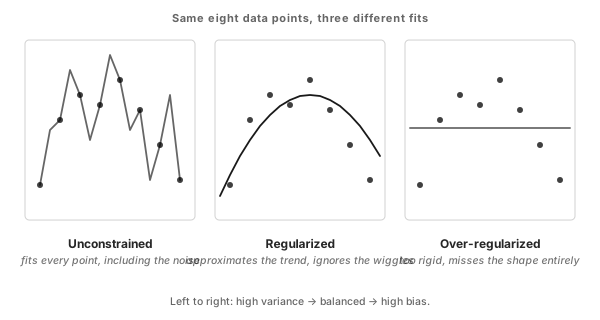
The sweet spot in that figure (around degree 3 to 5) is the narrow valley. At degree 1 the model is too simple to capture the curve at all. That is the lens that underfits. At degree 15 it whips through every training point and misses the underlying shape. That is the lens that overfits. Your belief model lives somewhere on this slider too, and the slider does not stay still over the course of a life.
Regularizers, and the value of deliberate constraint
The counterintuitive lesson is that staying in the valley sometimes means learning less from your data, or learning it more carefully.
In machine learning, a regularizer deliberately constrains a model’s flexibility so it cannot chase noise. You accept a small increase in bias (the model misses subtle patterns) in exchange for a large decrease in variance (the model stops hallucinating patterns that are not really there). The result is better performance on new data, even though the model fits its training data less perfectly.
In a belief model, the first regularizer is intellectual humility, not as a personality trait but as a working mechanism. The willingness to say “I’m not sure” despite deep experience is a constraint you impose on your own model to keep it from overcommitting to a pattern it has only half earned the right to commit to.
The second is deliberate exposure to disconfirming evidence, whether that means reading outside your field, talking to people whose intuitions clash with yours, or asking the question your model would normally suppress. Cognitive scientists call this last move a “consider-the-opposite” intervention. The discipline is to ask “what would have to be true for me to be wrong?” before committing to a judgement.
None of these are virtues in the moral sense. They are regularizers, working the same way regularization in machine learning works. You trade a small amount of resolving power inside the regime your model fits for a much larger gain in robustness when the regime changes.
Regularization also looks like simple rules of thumb. The psychologist Gerd Gigerenzer spent decades showing that fast-and-frugal heuristics often outperform sophisticated statistical models on new data. The simplest heuristics ignore most of what you know, use a single good cue, and decide. The reason they win is structural. The heuristic has high bias (it ignores most of what you know) but very low variance (it stays stable across samples). The elaborate model fits the training data exquisitely and falls apart on the next one. This is the formal reason experienced practitioners often trust their gut over the spreadsheet, and why they are sometimes right to. The gut is not less rigorous than the spreadsheet. It is a regularizer.
The deeper insight is about model capacity, the representational bandwidth available for fitting the world. Working memory, accumulated knowledge, and capacity for abstraction are all finite, and how you allocate them matters as much as how much of them you have. A chess master does not have more raw memory than a beginner. What they have is a library of encoded patterns. Thousands of board configurations stored as chunks let them see meaningful structure where a beginner sees only pieces. The capacity gain comes from encoding. You take high-dimensional raw experience and turn it into representations that preserve what matters and drop what does not. Neural networks do this when they learn useful features. Careers do it when they build expertise. The real question is always whether you are encoding the right things.
If the model encodes the wrong patterns (say, the surface features of past successes instead of the mechanisms underneath), more experience makes you more miscalibrated, not less. You become a more confident wrong-thinker. Regularization, at the level of a belief model, is the discipline that prevents this. It is the practice of holding your hard-earned patterns lightly enough that the next surprise can update them.
Double descent and the multi-dimensional life
The story gets stranger here.
For decades, the conventional wisdom in machine learning was that the bias-variance trade-off followed a U-shaped curve. Too little complexity meant underfitting. Too much meant overfitting. The sweet spot was somewhere in the middle. A 1992 paper formalised this picture and shaped the field for a generation.
In 2019, a team of researchers showed that the curve was incomplete. If you keep increasing model complexity past the point where the model perfectly memorises its training data, something unexpected happens. The error goes back down. They called the phenomenon double descent. After crossing the overfitting zone, the model lands in a regime where, among the many possible ways to memorise the data, the training process picks a simple, well-behaved one. The model is more complex than seems reasonable. It generalises anyway.
The figure below makes this concrete. The massive spike happens at the point where the number of parameters just equals the number of training points. The model has barely enough capacity to memorise the data, and any noise gets amplified catastrophically. Push past that point and the error drops steadily. Toggle the log scale to see the full dynamic range.
Something similar shows up in your life. Tim Urban’s career framework treats life as a multi-dimensional optimisation problem. You are trying to satisfy meaning, financial stability, autonomy, social status, and a handful of other tensions all at once. Urban calls the resulting object a “Yearning Octopus.” It has multiple tentacles, each pulling in a different direction, each carrying its own contradictions. Each tentacle is a sub-model of its own. It is a belief about what counts, weighted against the others, that generates the impulses showing up as your preferences.
The bias-variance trade-off runs on every tentacle at the same time. A career decision that reduces bias on the financial sub-model (you take the safe paycheck) often increases bias on the meaning sub-model (you stop exploring what you actually care about). A decision that reduces variance on the social sub-model (you stay where you have status) increases variance on the growth sub-model (you stop encountering situations that challenge you). The composite model is, in machine-learning language, badly overparameterised. It has far more degrees of freedom than any small sample of lived experience can pin down.
The double-descent connection follows. People who push through a phase of confusion and identity crisis, with too many interests and too many half-started paths and what looks from outside like a failure to commit, sometimes emerge with an integration that is more general, with richer internal structure, than the person who optimised narrowly from the start. The psychologist Robert Kegan described something close to this in his stages of adult development. He called it the self-authoring mind, one that can hold multiple frameworks at once and switch between them. The complexity works because the person has built the internal architecture (self-awareness, meta-cognition, tolerance for ambiguity) that selects good solutions from the vast space of possible lives.
The person who looks “behind” at 30 because they are still exploring may, at 45, be further ahead than the one who converged at 22. This is double descent in a life. It comes with a warning. The only way you survive the over-flexible phase is if the rest of your architecture (habits of attention, willingness to keep updating, tolerance for sitting with uncertainty) is doing the regularization work the parameter count alone cannot.
This is the third piece in the Powerful Belief series, following Belief Agency and The Most Dangerous Word. The framework draws on classical statistical-learning results (Geman, Bienenstock & Doursat, 1992), the modern double-descent literature (Belkin et al., 2019), and Gigerenzer on fast-and-frugal heuristics. The reframing of belief as a generative model, rather than as a stored proposition, extends the dispositional account developed by Eric Schwitzgebel and the multidimensional analysis introduced in The Most Dangerous Word. The argument continues in the companion piece, The Architecture of Resilience, which takes the trade-off up to organisations and civilisations.