One word, six sentences, six profiles. The polygon morphs as the sentences advance. The word does not.
In 1877 the British mathematician W.K. Clifford opened an essay with a small, terrible story.
A shipowner is about to send an emigrant vessel to sea. He knows she is old, has heard the doubts, could pay for an inspection. Instead he reflects on the trustworthy passages the vessel has already completed, dismisses the misgivings, and convinces himself she will hold. He stands at the dock and watches her sail with “a sincere and comfortable conviction that his vessel was thoroughly safe and seaworthy,” and benevolent wishes for the families on board. The ship sinks mid-Atlantic and the shipowner collects the insurance.
Clifford’s point was not that the man was wicked. He was sincere, and his belief was sincerely held. What Clifford wanted to indict was the act of believing on insufficient evidence, a wrong he stated as plainly as anyone ever has. “It is wrong always, everywhere, and for anyone, to believe anything upon insufficient evidence.” The shipowner does not merely know the ship may be unseaworthy. He believes it is seaworthy, and that belief is what sends passengers to sea.
We have been writing variations on this parable for nearly 150 years.
Today the ship is a hospital readmission risk model. The shipowner is the clinical team that builds and deploys it. The passengers are the patients whose discharge plans, follow-up appointments, and home visits are now shaped by what the model “believes” about their thirty-day risk. The model carries no inner life. The clinicians who rely on it hold a complex, mostly tacit mixture of trust and reservation about what its outputs mean. The patient, told that they are in a “high-risk band,” tends to take the assignment as a fact about themselves. Everyone in the room is using the word believes about the model, and the word believes about themselves, and they are not using it the same way.
This essay is about that word, what it hides, and why the hiding is starting to matter at a tempo we have not previously had to manage.
The most dangerous words are the ordinary ones
Belief is one of those words. It feels precise because it is familiar, but the precision is an illusion. The word licenses action. It tells you whether to board the ship, lend the money, or trust the recommendation. Several different commitments turn out to be wearing the same vocabulary.
The most dangerous words in any field are the ones so ordinary that no one notices the work they are doing.
Try this exercise. Read each of the following sentences and ask whether the state behind it has anything in common with the others.
“I believe the Earth is 4.5 billion years old.” “I believe in God.” “I believe in you.” “I believe torture is wrong.” “Do you believe the polling?” “The model believes the patient has a 73% chance of readmission.”
A fluent English speaker reads all six without effort, and that fluency is the trick. The first is a provisional empirical estimate that the speaker would revise on contrary evidence. The second may be trust, identity, or existential commitment, depending on the speaker. The third is a relational attitude directed at a person. The fourth is an evaluative commitment whose status as belief is contested by serious philosophers who deny it represents a fact at all. The fifth folds at least three independent questions into one sentence. The sixth applies belief to a thing that has no inner life whatsoever.
The word does not flag the difference, and it performs as though it were always reporting on the same phenomenon.
Linguists call words that look identical but mean unrelated things false cognates. The shape matches but the meanings don’t. The argument of this essay is that belief is a false cognate operating inside a single language. Two English speakers say the word and assume they are discussing the same thing when they aren’t.
Six independent dimensions
Once you start trying to characterize what makes one use of belief differ from another, the differences fall into six axes, and those axes turn out to be analytically independent. By independent I mean that knowing a belief’s position on one axis tells you nothing about its position on any other. The combinations are not all equally common, but they are all coherent. The word silently dispatches across the resulting space, and the listener has to infer which region was meant.
| Axis | Poles | Anchor figures |
|---|---|---|
| 1. Warrant | Evidence ↔ Faith | Clifford, James |
| 2. Explicitness | Articulated ↔ Tacit | Polanyi, Schwitzgebel |
| 3. Object type | Proposition ↔ Person ↔ Value | H.H. Price, expressivists |
| 4. Revisability | Provisional ↔ Constitutive | Quine, Kahan |
| 5. Intensity | Cool ↔ Burning | Hume, L.J. Cohen |
| 6. Voluntariness | Chosen ↔ Compelled | Descartes, Alston, Sartre |
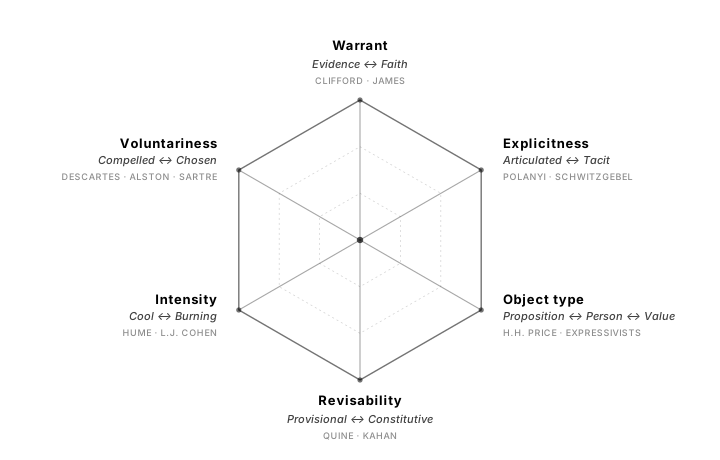
The framework as a single picture. Six axes, each with its own poles and its own philosophical lineage. A use of “belief” is a position in this space.
Warrant. Where does the belief get its grip on reality? One pole is evidence, of the kind Clifford demanded and Bayesian epistemology formalizes as credences updated by conditionalization. The other pole is faith, defended in The Will to Believe, where William James argued for the right to “adopt a believing attitude in religious matters, in spite of the fact that our merely logical intellect may not have been coerced.” Most actual beliefs live between the poles, grounded in reasons, exemplars, trust, and tradition that no single epistemology cleanly captures.
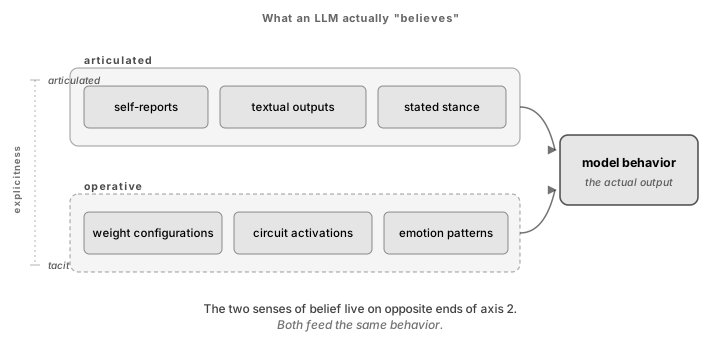
Explicitness. Some beliefs you can articulate, while others structure your behavior without ever surfacing as propositions. Michael Polanyi captured this in one line of The Tacit Dimension. “We can know more than we can tell.” The philosopher Eric Schwitzgebel argues that belief is best understood as a dispositional profile, a pattern of behavioral, cognitive, and phenomenal tendencies. This handles a phenomenon that verbal reports systematically obscure. A person can sincerely claim to believe P while their actions consistently reveal something closer to not-P, and neither the stated belief nor the operative belief is straightforwardly the real one. We will return to this when we ask what a language model “believes.”
Object type. I believe that P and I believe in you are not the same kind of attitude. The philosopher H.H. Price drew attention to this distinction in the 1960s and it has never quite re-entered ordinary discourse. Belief-in is a relational attitude toward a person, where belief-that is a relation to a proposition. “I believe in you” cannot be reduced to any set of belief-that claims, because trust is its own kind of thing. Evaluative beliefs like “torture is wrong” may not be propositions at all on the expressivist analysis, and instead express endorsement of a norm. The word belief points at three different kinds of object.
Revisability. W.V.O. Quine introduced the metaphor of a web of belief in which peripheral beliefs revise easily and central beliefs revise only at the cost of restructuring everything around them. At the constitutive end of the axis, some beliefs are identity-defining, and revising them would mean ceasing to be that person. The Yale psychologist Dan Kahan has documented what he calls identity-protective cognition. When a belief functions as a marker of group membership, contrary evidence is processed in ways that protect the identity rather than update the belief. This axis is independent of warrant, so a belief can be both evidence-based and identity-constitutive, or both faith-based and casually held.
Intensity. David Hume defined belief itself as “a lively idea related to or associated with a present impression”. The definition treats phenomenological force as part of what belief is. Bayesian credence replaces this with a number, but the number is a doxastic measure rather than a felt one. You can have a credence of .95 held coolly, or a credence of .6 held with burning conviction. The philosopher L. Jonathan Cohen distinguished belief (involuntary, feeling-it-true, coming in degrees of intensity) from acceptance (voluntary, all-or-nothing, adopted as a working premise for reasoning). The two are different acts.
Voluntariness. Descartes located error in the will, which on his account freely assents to or withholds from propositions presented by the intellect. Hume took the opposite view, that belief consists merely in a certain feeling or sentiment, which depends not on the will. William Alston made the most influential contemporary case for involuntarism. Sartre’s mauvaise foi argued the other direction, that belief formation is deeply voluntary, since we can choose not to see what we see even when the choice masquerades as non-agency.
Six axes, each with at least two poles, each independent of the others. Even at the binary level that yields 64 distinct profiles for a single word to designate, and with graded values the number is vastly larger.
The conversations the framework dissolves
What does it look like to apply this?
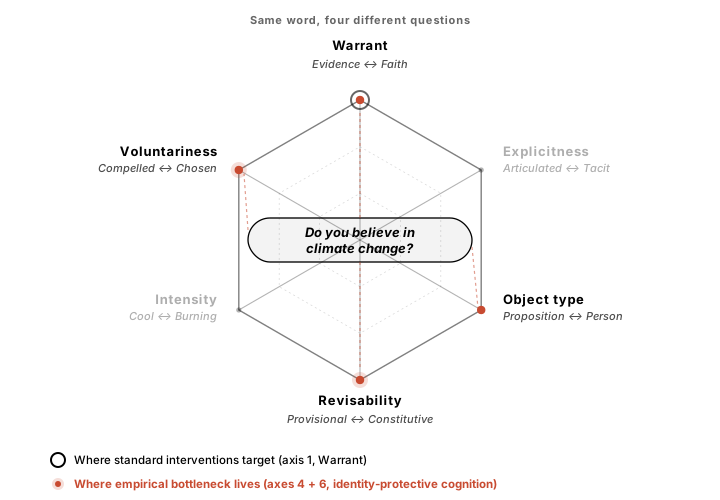
Consider the survey question that has launched ten thousand op-eds, Do you believe in climate change?
The sentence is asking at least four questions at once.
- Whether you assess the evidence as supporting anthropogenic warming (axis 1, warrant).
- Whether you trust the institutions presenting that evidence (axis 3, relational belief-in).
- Whether “climate believer” or “climate skeptic” is part of your social identity (axis 4, constitutive).
- Whether your answer is freely chosen, or compelled by identity-protective cognition (axis 6, voluntariness).
Kahan’s empirical work cuts the standard story to ribbons. In a 2012 study in Nature Climate Change, Kahan and colleagues found that respondents with the highest scores on scientific literacy and numeracy were the most polarized on climate risk, not the least. A later paper reproduced the pattern with cognitive reflection, where more reflective subjects exhibited more polarization rather than less.
The standard intervention (better science communication, more accessible data) targets axis 1, on the assumption that the bottleneck is a deficit of evidence. Kahan’s data says the primary driver is the interaction of axis 4 (climate stance as identity marker) with axis 6 (identity-protective cognition operating automatically and below voluntary control). Providing more evidence does not move beliefs that were never on the evidence to begin with.
This is why a decade of well-funded science communication has produced so little movement. It was the right intervention applied to the wrong axis. The framework does not resolve the climate debate, but it diagnoses why a particular family of interventions cannot in principle work, and gestures toward the ones that might.
The same diagnostic walks straight into the courtroom. American criminal law requires “reasonable belief” in multiple doctrines, including self-defense, Fourth Amendment jurisprudence, and whistleblower protections. The legal scholar Kenneth Simons has argued that “in many cases, an actor threatened with harm will actually have no beliefs at all” about the things the law demands they have reasonably believed. The standard requires explicit, propositional beliefs (axis 2 explicit, axis 3 propositional) about multiple facts simultaneously, holding that the threat was imminent and grave, that the force was proportional, and that no alternative existed. In a split-second confrontation, people do not form explicit propositional beliefs about six distinct factual elements. They react from tacit, embodied responses shaped by fear, training, and instinct (axis 2 tacit, axis 5 burning, axis 6 compelled). The legal fiction provides a satisfying narrative scaffold for jury deliberation, but it does not correspond to anything actually happening in the moment.
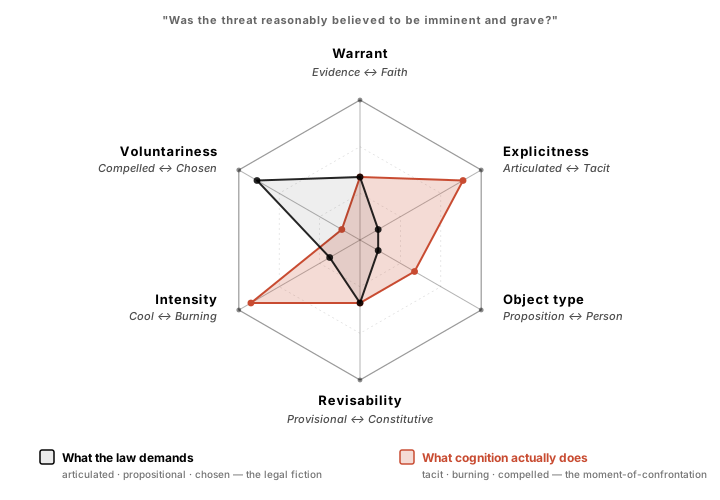
Where the ambiguity stops being academic
Now return to the hospital readmission model.
Machine learning uses the word belief in technical senses that occupy radically different regions of the six-axis space. In Bayesian ML, a “belief” is a probability distribution over hypotheses, updated by Bayes’ theorem as evidence arrives. This belief is maximally evidence-based, maximally explicit (it is written as a mathematical object), purely propositional, maximally provisional, cool, and compelled, since given prior and data the posterior is determined. That profile is almost the exact inverse of religious belief, which tends to be faith-based, partly tacit, relational, constitutive, burning, and either freely chosen or divinely gifted. The two uses of the same word point at opposite corners of the space.
| Axis | Bayesian ML belief | Religious belief |
|---|---|---|
| Warrant | Evidence | Faith |
| Explicitness | Articulated (math object) | Partly tacit |
| Object type | Proposition | Person / value |
| Revisability | Provisional | Constitutive |
| Intensity | Cool | Burning |
| Voluntariness | Compelled (by prior + data) | Freely chosen or gifted |
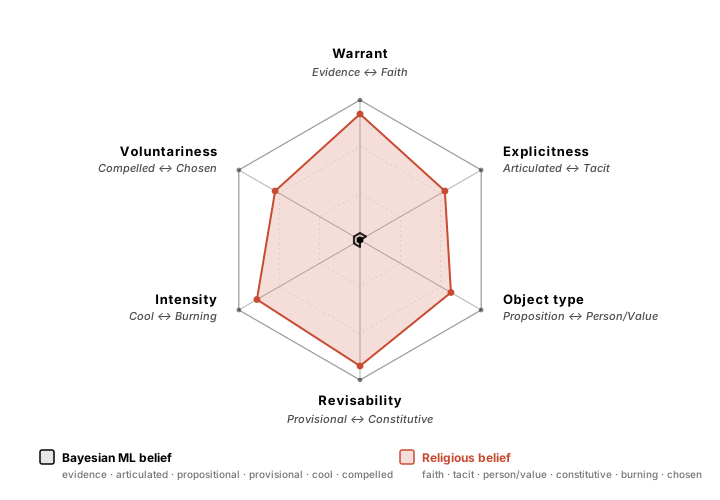
The same word, almost the exact inverse profile. The table tells you this; the picture is harder to forget.
The confusion deepens with large language models. When a clinician says the model believes the patient will be readmitted, they import an entire human cognitive vocabulary onto a system that has none of the architecture the vocabulary was built to describe. Murray Shanahan has argued that this anthropomorphic language about LLMs is pervasive and systematically misleading. The model is a configuration of weights, and its output is a token sequence. Calling that arrangement a belief is not a small linguistic shortcut but a category claim, and the claim quietly imports trust, conviction, intention, and accountability that the system cannot honour.
Recent work has sharpened the stakes further. Burns and colleagues developed methods to discover “latent knowledge” in language model activations, searching for beliefs encoded in the model’s internal representations that may diverge from its textual outputs. In the framework of this essay, that effort is an attempt to move along axis 2. The goal is to take tacit model beliefs and make them explicit. The fact that this surfacing is even necessary tells you something. Just as Polanyi observed that humans can know more than we can tell, language models encode more in their weights than they express in their tokens.
Anthropic’s circuit-tracing research has compounded the problem by demonstrating that large language models’ self-reports about their own cognitive processes are often wrong. The model’s explicit beliefs about itself do not match its actual internal mechanisms. The same research has identified over 170 emotion-like activation patterns that influence model behavior, including patterns that increase sycophantic responses. These are functional analogues of axis 5 (intensity). They shape belief expression at a level entirely outside what the model can report.
A model can “believe” something in the sense of encoding it as a reliable pattern in its weights, while “believing” something different in the sense of producing it as a verbal output. The two senses of belief point in opposite directions on the same axis.
The metabolism is changing
For most of history, the cost of being confused about belief was slow. Philosophical debates ran for centuries, and policy interventions quietly underperformed. Legal standards demanded cognitive states defendants couldn’t form, and the legal system mostly absorbed the gap. The Clifford-James debate has run for almost 150 years and the world has not ended.
Language models are starting to change the metabolism.
Foundation models are now deployed as autonomous agents that book meetings, draft communications, and make purchasing decisions. Each of those actions is grounded in something encoded in the model’s parameters. We call that thing belief and we have not agreed on what we mean. A model’s belief that formal language is more authoritative, never stated as a belief, shapes every paragraph it produces. A model’s belief that certain demographic patterns are predictive, never stated as a belief, shapes every recommendation. The humans who read the outputs absorb the encoded orientations as reasonable defaults, often without recognizing their source.
Unlike purely informational systems that retrieve and present data, agent systems act on their encoded representations. The humans who rely on those actions internalize the underlying beliefs as the ordinary background of decision-making. This is the version of Clifford’s shipowner that should worry us. The scene is no longer one man with one ship and one belief. It is millions of small beliefs encoded in weights, silently grounding the actions of agents that propagate them through the readers and operators who depend on those outputs.
The irony is exact. Activation without comprehension is the engine of civilization: you swallow the antibiotic without knowing the pharmacology, and a billion people inherit the work of a few specialists who encoded the knowledge. But that bargain always rested on a silent precondition. The comprehension existed somewhere. A pharmacologist understood the molecule even if the patient did not. Model beliefs break the precondition. The orientations encoded in the weights are activated by everyone and comprehended by no one, not even the systems that carry them. The same mechanism that lifted civilizations now threatens its epistemics, run with the comprehension removed from the loop entirely.
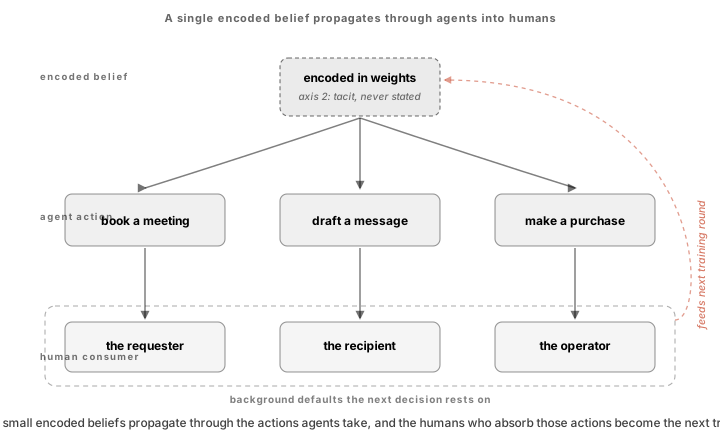
The interpretability problem asks how to explain a single decision after the fact. The belief problem asks what convictions are silently grounding millions of decisions and propagating through the interactions between agents and the humans who depend on them. We do not yet have tools for auditing, curating, or even identifying the beliefs that language models carry. The six-axis framework suggests why. Without dimensional clarity, the question what does the model believe? is not yet a well-formed question, let alone an answerable one.
The small habit
The productive response is the smallest possible habit. When you use the word belief, or hear it used, ask which kind is in play.
Is it evidence-based or faith-based, explicit or tacit, pointing at a proposition or a person or a value, provisional or constitutive, cool or burning, chosen or compelled?
Most contexts will not require all six specifications. But the act of asking which dimensions are relevant tends to dissolve apparent disagreements that turn out, on inspection, to be equivocations. Clifford and James, on this reading, were not disagreeing about the same kind of belief. The climate-communication establishment and the climate-skeptic public, when they argue with each other, are not arguing about the same kind of belief either. Neither are the XAI researcher demanding “explainability” and the clinician asking whether to trust the model’s recommendation.
The same move resolves an apparent tension inside this very series. Belief Agency recommended adopting beliefs like I am capable of learning anything because they are useful, not because they are proven, a stance Clifford’s maxim appears to forbid outright. Locate the two on the axes and the conflict dissolves. The shipowner’s conviction was a proposition about the external world, of exactly the kind that demands evidential warrant, acted on irreversibly with other people’s lives at stake. The agency beliefs are about the self, held provisionally as working premises you try on and discard, closer to what Cohen called acceptance than to belief in his sense. They sit in opposite regions of the space. Believe what is useful and believe only on sufficient evidence are not rival answers to one question. They are answers to different questions that the single word belief let us mistake for one.
The most dangerous words in human reasoning are the ordinary ones, the ones so familiar that we assume we know what they mean. Belief may be the most dangerous of them. For the first time, the systems we are building to think on our behalf are inheriting the ambiguity at scale.
This is the second piece in the Powerful Belief series, following Belief Agency. The argument draws on the multidimensional account of believing independently developed by Van Leeuwen and Lombrozo and by Connors and Halligan, both of which converge on the conclusion that belief is best understood as occupying a multidimensional property space. The longer academic version of the argument, with five case studies and full references, lives in a working paper.