Image Reference Sheet: Compress, Retrieve, Activate
Click each link to view and download. 15 candidates across 6 proposed placement slots.
SLOT 1: The Physics of Processing Knowledge (IBM Mainframe / Early Computing)
Placement: Opening, “The physics of processing knowledge” / Landauer section
Landauer proved at IBM in 1961 that erasing one bit costs energy. Computation is physics. The physical bulk of these machines makes the point visually.
-
1a. IBM System/360 computer room (1960s, operators at console): https://upload.wikimedia.org/wikipedia/commons/5/55/IBM_System_360_Model_30.jpg
-
1b. IBM 704 mainframe at NASA (1957, room-scale computing): https://upload.wikimedia.org/wikipedia/commons/3/3e/IBM_Electronic_Data_Processing_Machine_-_GPN-2000-001881.jpg
-
1c. ENIAC (1946, the first general-purpose electronic computer, operators visible): https://upload.wikimedia.org/wikipedia/commons/4/4e/Eniac.jpg


SLOT 2: The Brain as Compression Engine (Brain Scan / Neural Visualization)
Placement: “Compress” section, near Kahneman / ACT-R / dual process theory
The biological compression engine: billions of connections shaped by experience, encoding compressed patterns. System 1’s instant recognition made visible.
-
2a. Diffusion tensor imaging (DTI) of brain white matter tracts (colorful neural pathways): https://upload.wikimedia.org/wikipedia/commons/f/f4/White_Matter_Connections_Obtained_with_MRI_Tractography.png
-
2b. Functional MRI of human brain during cognitive task (sagittal view, regions lit up): https://upload.wikimedia.org/wikipedia/commons/e/e5/Functional_magnetic_resonance_imaging.jpg
-
2c. Neuron network, fluorescence microscopy (Brainbow technique, individual neurons in color): https://upload.wikimedia.org/wikipedia/commons/e/e2/Brainbow-cell1.jpg


SLOT 3: Retrieval Infrastructure (Library of Alexandria / Historic Library)
Placement: “Retrieve” section or “Intelligence of civilizations” / retrieval at scale
Humanity’s earliest attempts at civilizational-scale retrieval: organizing the world’s compressed knowledge so it could be found when needed.
-
3a. Interior of the Trinity College Long Room library, Dublin (200,000 books, barrel-vaulted ceiling): https://upload.wikimedia.org/wikipedia/commons/c/c3/Long_Room_Interior%2C_Trinity_College_Dublin%2C_Ireland_-_Diliff.jpg
-
3b. Reading room of the Library of Congress (ornate ceiling, circular reading desks): https://upload.wikimedia.org/wikipedia/commons/3/3d/LOC_Main_Reading_Room_Highsmith.jpg
-
3c. Card catalog drawers (pre-digital retrieval, the physical infrastructure of finding knowledge): https://upload.wikimedia.org/wikipedia/commons/b/b5/Katalog_alfabet_-_Loss.jpg


SLOT 4: Tools as Compressed Knowledge (Stone Tool Progression)
Placement: “Tools: compressed knowledge made activatable” / Kapp, Leroi-Gourhan section
Compression quality improving over two million years, visible in stone. Each successive tool encodes more knowledge of fracture mechanics and ergonomics in its physical form. The visual progression is the argument.
-
4a. Oldowan chopper (~2.5 million years old, crude, first stone tools): https://upload.wikimedia.org/wikipedia/commons/1/11/Oldowan_pebble_chopper.jpg
-
4b. Acheulean hand axe (~500,000 years old, symmetrical, refined): https://upload.wikimedia.org/wikipedia/commons/7/7b/Biface_Silex_Venerque_MHNT_PRE_.2009.0.194.1_Fond.jpg
-
4c. Progression of stone tools from Oldowan to Mousterian (multiple tools, evolutionary sequence): https://upload.wikimedia.org/wikipedia/commons/8/84/Acheulean_hand-axe_from_Egypt.jpg


SLOT 5: The Printing Press / Externalization of Memory
Placement: “Tools” section, Leroi-Gourhan’s second externalization / democratization of retrieval
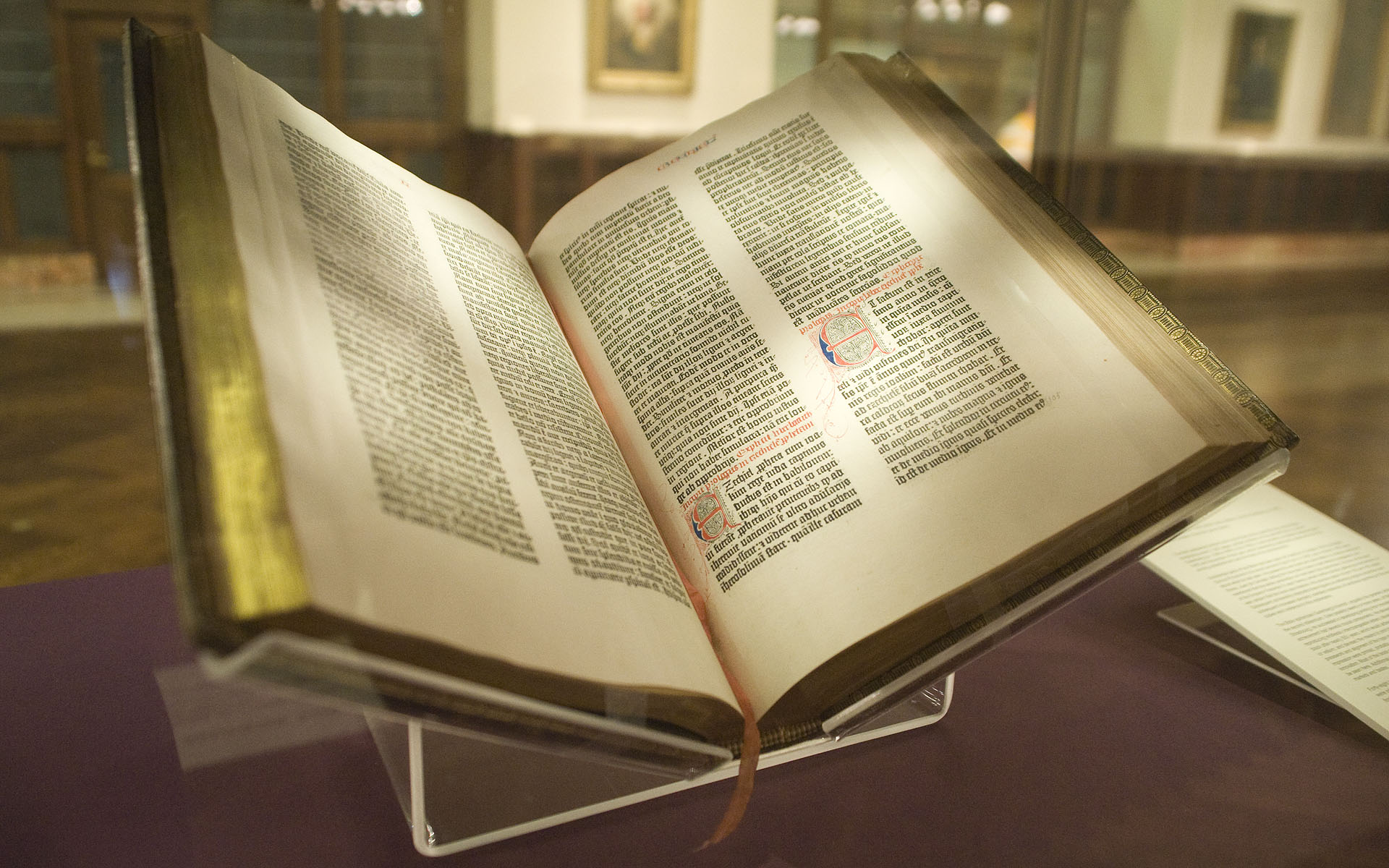
The hinge between individual and civilizational knowledge systems. Compressed knowledge made mass-reproducible. Retrieval democratized.
-
5a. Gutenberg printing press (reconstruction, wooden frame, movable type): https://upload.wikimedia.org/wikipedia/commons/c/c3/PrintMus_038.jpg
-
5b. Movable type close-up (individual letter blocks, the unit of externalized knowledge): https://upload.wikimedia.org/wikipedia/commons/a/a9/Metal_movable_type.jpg
-
5c. Gutenberg Bible page (the first mass-produced book, knowledge made durable and portable): https://upload.wikimedia.org/wikipedia/commons/b/b6/Gutenberg_Bible%2C_Lenox_Copy%2C_New_York_Public_Library%2C_2009._Pic_01.jpg


SLOT 6: Earth at Night (Civilizational Intelligence)
Placement: “The intelligence of civilizations” or closing
The cognitive niche made visible from space. The accumulated compress/retrieve/activate infrastructure of human civilization, glowing against the dark. Connects back to Piece 1’s closing.
-
6a. NASA Earth at Night composite (full globe, Americas facing): https://upload.wikimedia.org/wikipedia/commons/a/a8/NASA_earth_at_night.jpg
-
6b. Earth at Night, Black Marble (2012, full globe, high resolution): https://upload.wikimedia.org/wikipedia/commons/7/79/The_earth_at_night_%28blackmarble_2012%29.jpg
-
6c. Europe at night (detail, dense network of cities visible): https://upload.wikimedia.org/wikipedia/commons/2/2a/Europe_at_Night.jpg


Visual arc summary
| Slot | Image | Section | What it represents |
|---|---|---|---|
| 1 | IBM mainframe / ENIAC | Physics of processing | Cognition is thermodynamics, computation is physics |
| 2 | Brain scan / neurons | Compress | The biological compression engine, System 1 made visible |
| 3 | Grand library interior | Retrieve | Civilizational retrieval infrastructure across history |
| 4 | Stone tool progression | Tools as compressed knowledge | Two million years of compression quality, visible in stone |
| 5 | Printing press / type | Externalization of memory | Retrieval democratized, knowledge made mass-reproducible |
| 6 | Earth at night | Civilizational intelligence | The cognitive niche glowing against the dark |
The visual trajectory: Room-sized computer → biological brain → grand library → stone tools → printing press → Earth from space. The arc mirrors the essay’s argument: from the physics of individual computation, through biological cognition, through retrieval systems, through tools as compressed knowledge, through the technology that scaled transmission, to the civilizational result visible from orbit. The movement from the intimate (a brain scan) to the cosmic (Earth at night) visually enacts the piece’s central claim that the compress/retrieve/activate loop scales from neurons to civilizations.
The strongest pairing: Image 4 (stone tools) and Image 5 (printing press) placed near each other in the tools section. The stone axe is compressed muscular knowledge. The printing press is compressed memorial knowledge. Together they visually enact Leroi-Gourhan’s three externalizations, with the third (computation) already covered by Image 1.